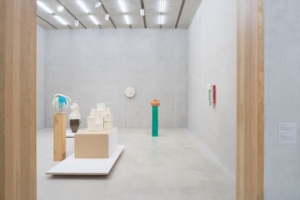
NICOLE CHERUBINI: During my first site visit, a hardhat tour, the museum was about halfway constructed. Most of the gallery walls had been poured, but the guts of the building were raw cast concrete and the sheetrock hadn’t been put up in any of the spaces yet. In the gallery where my show is, the walls had been poured and they retained a lot of information from that process—swirls and writing and marks from the forms they were poured into. The most incredible thing that came to me was just how beautiful that poured concrete was. The exterior facade hadn’t been built at all, and the construction crew and the museum staff were all in hardhats. It was kind of incredible.
RAIL: How did those early impressions of the space influence the way you approached making the work in your exhibition?
CHERUBINI: It definitely had an influence on how I used the materials. Knowing that the walls would have texture and patterns led me to rethink how the pieces would exist on them—that there could be a symbiotic relationship between the two where one references the other. The most surprising thing, which I didn’t really understand until I installed, was that because every surface in the gallery is the same material—cast concrete—it was like installing in a seamless space where the work can defy gravity. There was no line between the wall and the floor, which is the most incredible gift for a sculptor. The other thing that struck me was the particular gray tone of the cast concrete, and how my colors were going to be affected by those walls. Colors that seemed a little off in my studio became more vibrant and more subtle at the same time when the work was installed in the gallery. The concrete is a warm gray, it’s not a cool gray, so it warms everything up and balances well with of all the beautiful wood that’s in that space. The museum is incredible.
RAIL: I think about all of the activity that you describe when you toured the site, especially all of the workers in hard hats constructing these floating galleries, and it reminds me of Rudolf Steiner’s lectures on bees, which I know you read when you were researching utopian communities. Do you think a museum can be a utopian space?
CHERUBINI: I’ve thought about that a lot and I see a museum more as a spiritual space. I feel an incredible sense of awe when I’m in a museum…for me it’s like a church. I know that can be a spiritual position, and I would think it depends on the individual. From all the research I did on utopian communities, I believe that many of these movements function through collective consciousness. But for me, the museum evokes a sense of individual spirituality.
RAIL: Interesting, I think of a museum as a civic space, an expression of culture in a community.
CHERUBINI: I don’t necessarily think that a spiritual space isn’t community oriented. I would have to say that those realms are very intertwined. There is an inherent sense of respect in a museum, at least for me there is. I think that these ideas of community, culture and spirituality can come together in a museum.
RAIL: Especially in this museum, with its position at the edge of the city, overlooking the bay. The visual experience can be very meditative in terms of how the artwork is framed within the building and how the view of the water or the city is framed by the building.
CHERUBINI: Completely, and also how the work is framed in relation to every other exhibit in the museum. So there’s an acute sense of awareness that encourages us to make connections and understand different parts as a whole.
RAIL: In your exhibition, I bounce back and forth between formal elements in the work and the built environment. For example, my eye bounces from the thin pedestal wrapped in green plastic to the wall piece with the glassy green glaze on it, and both resonate with the hanging garden column outside, which is visible from the gallery. These repeated forms point back to the hive. Maybe we can talk about that repetition and reproduction and how that relates to your medium—clay.
CHERUBINI: One thing that came together exceptionally well for me in this show is that, moving through the space, each element leads to something else. I love that you referenced the green pedestal, the green glaze, and the hanging foliage. There is an inherent connection between all of these diverse parts, which I tried to manifest formally but also via materials and touch. The physical act of manipulating the clay is what connects the work back to the conceptual underpinnings. There’s a tension between trying to figure out how to actually be in it while making, it as opposed to making the work about it.
RAIL: The materiality of the clay is very evident, every piece bears the imprints you leave as you’re making it—you press slabs into the cardboard box molds, even the bronze piece bears finger impressions. You see the human touch in each of the individual modular units that make up the whole. Your embodiment of utopian craft practices functions on a micro and macro level in the work.
CHERUBINI: Going back to the space as a starting point, the clay pieces on the wall have that gray swirly surface. The glaze I chose deliberately talks to the wall, in the same way the green moves around the room. I wanted the walls to be part of the piece within the space. Placing the unglazed clay pieces on the raw concrete wall creates a physical connection, a material resonance, but the way the light is absorbed by the different materials creates a contrast. I think so often about the way in which unglazed clay absorbs light and glazed clay reflects it, and what that actually says—how the same material can actually have that conversation, one taking in light and one giving it back.
Panel #1 and #2, 2014; Earth Pot #6, 2014. Installation View Pérez Art Museum Miami. Photo by Miami Fine Art.
RAIL: I’m thinking about the feminist adage that “the personal is the political,” and I feel like you have figured out hot to incorporate a feminist ethic into your work in an embodied kind of way—
CHERUBINI: Thank you. That’s the nicest thing anyone has ever said to me. [Laughs.]
RAIL: [Laughs.] So, what is feminism to you? How do you think about it in the studio or in terms of art?
CHERUBINI: I think feminist voices need to be heard in a way that is true and honest within a history that has already been written. The hexagons are my first movement into trying to develop a physical stance for that, because the hexagon is not a closed form, it’s additive. You see one and your mind imagines more and more. I think about trying to pull alternative histories into the conversation, and not just the history of the 1970’s feminist art movement. Artists like Hannah Wilke are beyond important, but I want to look further back. Since I’ve had children, I realize that I can actively shape an existence in this world, which is so important as the world is shying away from a sense of equality between genders. I have realized the responsibility I have now—that our actions today create the conversation for the years to come.
RAIL: I like that you brought up Hannah Wilke and I especially see an affinity with the kneaded eraser and chewing gum pieces. What other artists do you feel a special affinity with?
CHERUBINI: There are sculptors working in clay who have definitely been influential to me, like Beverly Semmes and Rebecca Warren, a group of artists who are well known as ceramics people. They have given me the strength to keep going with it. I recently saw a show of Charles Long’s brass pieces, and I’ve loved his works for years. I look a lot at painting- Rebecca Morris is one of my favorites. I sometimes wish I could exist in one of them. And I like a lot of like really old pottery, like Greek pottery, and the American potter George Ohr. I’m kind of all over the place.
RAIL: My last question is about ceramics in academia right now. A lot of professors who taught our generation of artists are retiring, and I’ve been seeing ads for academic positions in ceramics. Ceramics programs are kind often interesting within university art departments because in order for them to function they have to have a lot technology and equipment and it has to be well-maintained and functional—unlike film or photo departments, for example, which sometimes shift to digital and shed their darkrooms. When someone retires and these positions are advertised, universities are looking for artists who can bridge the gap between technical knowledge and a more conceptual position of the medium in contemporary art. This can override the fine craft aspect of ceramics. What do you think about that kind of transition in terms of the future of the medium?
CHERUBINI: What I really appreciate about ceramics departments is that they are actually multidisciplinary, incorporating fine art sculpture, as well as function and craft, and then it also has a design element to it that is very present. In some ways, I kind of think it’s like the most community-based and maybe contemporary department that can exist. It’s wonderful to bring new people in, which creates a new perspective on the material that doesn’t have to be embodied in the history. But there is also something powerful about that restraint of being beholden to history. I’m actually very conflicted on the whole subject. My husband is a potter, and I have a very close relationship to the material and to the fact that there are so few schools where one can learn to be a really good potter. It would be a shame if that all disappeared.
Source 2012
[NAME] Publications
“Source, with transcendental passages of analogy and allegory is an invitation to a reality of Americana, slightly off, but slightly right. If “a mythology reflects it region” Source achieves a high-grade vision of Floridian, Southwestern, American mythemes—linking various locales together.”
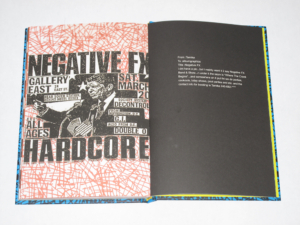
“We find curious sequences: an image of a logo “Beaver Brand Paddles and Oars” that decomposes in subsequent pages of beaver butchery, rendering the animal, a view of an interchange of the subject and its fragments that reconstitutes throughout the kernel of a world. One suspects the exercise tilts toward a polemic. This is, perhaps, a thinking of shock values in a digital age as we find a row of disembodied beaver tails drying against a blue sky. The peculiarity of allegory is a question of image propulsion. This disrupts the act of turning pages.”
–From a review by Adam Staley Groves in Singapore Review of Books
Source is available on Amazon.com.
[NAME] Publications was founded in 2008 by Gean Moreno, a Miami-based artist and writer whose own recent works in the form of texts, prints and sculpture (undertaken collaboratively with Ernesto Oroza) document and ruminate on the building blocks of contemporary material culture. Moreno made the leap from newsprint, milk crates, speaker boxes and cast concrete to the hardcover book with the intention of offering artists an exhibition venue in book form.
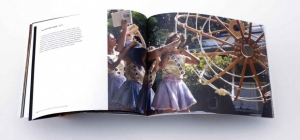
The imprint’s newly released fourth title is Nicolas Lobo’s Album Graphics. The book documents the artist’s foray into the contemporary D.C.-area Go-Go music scene, a genre rooted in 70’s funk and early rap with an emphasis on live performance, in the guise of a graphic designer. Lobo’s web-based negotiations with Go-Go musicians and promoters via genre-specific online forums are documented with much of the formatting and informal spelling intact. The book is full of Myspace screen captures, t-shirt designs, photo backdrops, video stills and promo flyers for Go-Go shows, some of which were produced by Lobo. Album Graphics archives an artist’s project that, while deeply engaged with unsanctioned modes of cultural production, would otherwise remain formless.
Below, Gean Moreno delves into some questions about form, formlessness and invisible architectures.
CHRISTY GAST: How does a book become a venue?
GEAN MORENO: Through a kind of willed ignorance. Although I’ve always been into books, particularly graphically odd ones (the lineage that comes down from Tristam Shandy) and other kinds of less formal publications, I know nothing about book production or design. Instead of learning about these things, I told myself that a book was like an exhibition venue, confusing two different kinds of containers. That’s the experiment. What I like about thinking of the book as a “venue” is that this in turn invites artists to stick in books what they would usually stick in buildings–works. That is, it suggests the possibility of thinking the book as a space onto which the ideas that inform their practices can spill, or extend, or simply cross. (Rather, I supposed, than be contained, as it usually happens with monographs and other book-books.)
CG: What parameters do you give artists at the beginning of a project?
GM: The books should be 6″x9″, hardcover, about 100 pages, 4-color. That’s it.
CG: You describe [NAME] Publications as a “malleable platform for book-based projects,” implying that the default format is rigid or inflexible, and the proper position from the artist’s standpoint is to hack or deform the book. How have the first four publications from the imprint approached the book as an object?
GM: I think the “malleable platform” bit was a kind of preemptive move, something said to justify any turn away from actual books in the future. What has been most interesting about the books produced thus far is how they have had to negotiate the book as a physical and generic artiact and the technologies that organize our lives. Daniel Newman’s WWW and Nick Lobo’s Album Graphics are “internet” books. Newman, making a contemporary version of the 18th century dictionary of ideas, went to the same place we all go to collect information and ideas these days. He not only employed the internet as a resource, but allowed it to stand emblematically for the source or generator of our contemporary knowledge. He literally downloaded 120 pages-worth of material, alphabetized the textual parts, and…that’s it. The result, of course, is much more interesting than this description suggests.
Beatriz Monteavaro took the opposite approach in Quiet Village–opposite, up to a point. She produced a scrapbook. It’s filled with her drawings and her notations. It’s a total return of the personal, of the author, etc. And yet, at the end, she just scanned everything. One almost sees this feeding of her unique drawings into the scanner as a kind of stand-in for her feeding them into the vast generic universe of endless reproduction and strict digital codes. And this, I think, changes everything, complicates this return to the intimate and the personal. There is something interesting at the frictional interface or faultline between “obsolete” books and digital technologies (and the generic systems these generate). These books, as a collection, seem to be setting up camp at the edge of this faultline.
CG: Is there a common thread, conceptually or otherwise, linking the artists you selected for the first four publications?
GM: The selection is a bit intuative. If an artist is working with an interesting set of ideas and it’s difficult to know how this would translate into a book–this is usually enough to make me start thinking about them.
CG: What’s next for [NAME] Publications?
GM: Viking Funeral is up next.
CG: Where are the books sold?
GM: www.namepublications.org, Printed Matter in New York, Boekie Woekie in Amsterdam, Sweat Records, Books & Books, Miami Art Museum, and the Bass Museum in Miami.
~Christy Gast
2011
Published by Gallery Diet
With an essay by Ruba Katrib
Subjecting the landscape to a critique, as an art object or any object in material culture, allows one to tease out a narrative in reverse. The broad view is pictorial: mountains, clouds, horizon lines, ground cover. The details, the small pieces, even holes and missing parts creep out and ask to be analyzed. Enigmatic fragments gain extra significance as they point in many directions, towards political, technological, and social histories that have shaped the landscape. Magical objects, laden with poetics, converse with each other. Of course, all of this subjecting is subjective and illuminates preoccupations and prejudices of the artist.
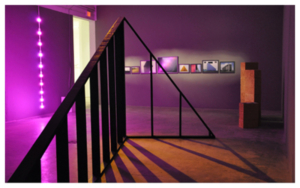
I Saw Three Cities, Felecia Chizuko Carlisle’s solo exhibition at Dorsch Gallery, takes its title and leitmotifs from a painting by early 20th century surrealist Kay Sage. In the painting, the pictorial space is partially framed by a wrapped and windblown length of canvas resembling a massive figure with an outstretched arm. Triangular walls recede into the arid, indeterminate distance casting stark shadows on ambiguous architectural forms.
By manipulating light and shadow, Carlisle translates Sage’s investigations of expansiveness into an installation both sparse and quietly kaleidoscopic. Ostensibly consisting of discreet works of sculpture, video and photography, all works in the show are united by a central piece, Untitled, a 12-foot long solar-powered chandelier. The swooping diagonal of ten pink bulbs colonizes every surface in the long gray room with its sun-harnessed glow.
The far wall is occupied by a large-scale video projection entitled Pink Army/Pink Rectangle, altered found footage of a military parade in which all of the soldiers happen to be women in fuschia uniforms and luminous white berets. The army marches nowhere, forever, in perfect harmony, at times obscured by a pink frame. Frames and framed-out structures interlink as one moves through the space. A sculpture called Unusual Thursday, another title borrowed from Sage, is situated opposite the chandelier. Constructed of a polymer decking material called Lifetime Lumber (presumably selected for its allusion to infinity), the piece resembles two framed-out walls striving to be a pyramid, pointing with a flourish back to the forever-marching ladies.
A suite of photos documenting shadows, reflective surfaces, abstracted utilitarian architectural elements and one monumentally unfinished high-rise building are hung in a long row, the scale and texture of each individual image collapsed and punctuated by the spectre of the solar chandelier. It is the most immeasurable and intangible material in the exhibition, transformed sunlight, that converts so many contrasting formal elements, raw materials, and surfaces into a meditation on potentiality.
~Christina Gast

Images: Installation views. Courtesy Dorsch Gallery.
Corin Hewitt’s practice fuses photography, sculpture and the sort of critical inquiry into the classification of natural and cultural objects normally undertaken by scientists and spirited amateur collectors. At Dorsch Gallery until June 5, an exhibit of Hewitt’s carefully arranged still-life photography entitled “Drying Flowers in a Microwave” features studio shots of flower arrangements with a formalist bent.
Installation view of Drying Flowers in a Microwave May 8, 2010
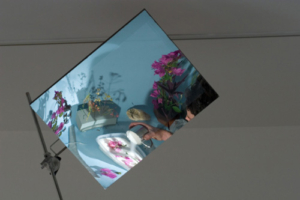
Anyone entering the gallery on opening night was confronted with four empty walls, and a curious crowd craning their necks upward. One of the walls was shorter than the rest and revealed an inaccessible chamber at the back of the gallery where, with the assistance of mirrors hung strategically from the ceiling, viewers could access cropped partial reflections of the artist as he pondered and composed the arrangements.
Untitled #1 from Drying Flowers in a Microwave May 8, 2010
During the first weeks of the show, Hewitt busied himself with collecting specimens, drying and arranging them in the sequestered production area, and printing the photos that were eventually displayed on the gallery walls. The plant matter he manipulated to form the sculptures was collected in Vermont and Miami. In the following video, recorded at historic Palm Lodge near Homestead, we join Hewitt as he gathers plant material for his project, explains how to dry flowers in the microwave, and ruminates on life, death and biology.
A few weeks ago nearly a hundred academics, artists, educators and critics descended upon the University of North Carolina’s Asheville campus for an on-site conference examining the legacy of Black Mountain College, the first since the institution’s closure in 1957. Founded in 1933 by a group of academics and students eager to practice theories of progressive education, Black Mountain College held the arts and creative inquiry in high esteem, hosting John Cage, Merce Cuningham and Buckminster Fuller at the isolated Appalachian campus early in their careers. Faculty-owned, Black Mountain College offered an approach to higher education radically different than typical colleges of its day. Students, faculty and staff lived communally, classes were open-format, and students developed their own courses of study. Students and faculty alike were committed to their experiment, although the college’s finances were always tenuous. Food was grown at the college farm, students maintained the campus themselves to save money, and faculty often worked without pay. The college ultimately ran out of funds in 1957, but its faculty and alumni went on to become major cultural contributors for the remainder of the 20th century.
Lee Hall porch. Photo courtesy North Carolina State Archives, Black Mountain College Papers.
The conference hosted such a comprehensive yet uneven array of panels and presentations that, moving from lecture to lecture, one got the feeling of strolling through a live-action mockumentary staged by Christopher Guest. A number of panels debated the legacy of BMC in arenas such as critique-based art education in California graduate programs, the queer community, practicing contemporary artists, and pottery education. A discussion heavy on the minutia of daily life at Black Mountain College (a tuna casserole dinner was served on the porch of Lee Hall some time in 1937) gave way to a debate about whether Cage’s first happenings at the Eden Lake campus were an early, atemporal instance of postmodernism. Eva Diaz from Pratt discussed the politics of geodesic domes in contemporary art, while the next presenter obliquely described a college he started in Pennsylvania before stumping for donations. Next to an indoor Bucky-ball playground situated under an idiosyncratic wall-sized public art adaptation of the School of Athens, a panel on Chance Operations saw three simultaneous presentations accompanied by prepared guitar, feedback pedals, and voice interjections.
iPhone photo of Chance Operations panel by Terry Berlier.
Bucky-balls and The School of Athens at UNC Asheville.
Buckminster Fuller at BMC.
BMC operated on a shoestring budget in the remote Blue Ridge Mountains of North Carolina from Great Depression until the McCarthy era of the mid-1950’s and was viewed with some apprehension by its Appalachian neighbors, compounding the community’s fiscally-imposed ethic of radical self-reliance. In contrast to the nearby Biltmore Mansion, a relic of the Gilded Age stuffed with valuable antiques and portraits by Seargent and Whistler of Anderson Cooper’s industrialist ancestors, the Vanderbilt clan, BMC’s Eden Lake campus consisted of a sprinkling of rustic lodges and one student-built modernist structure, the Studies Building, encircling a small reservoir. Along with small private studies for each student and faculty member, the Studies Building housed the studios of Nazi refugees Anni and Joseph Albers, whose influence on the teaching of art resonated far beyond BMC.
BMC students at looms.
Foosbal and lanyard supplies in Anni Albers’ former weaving studio.
On the day that conferees and former students toured the Eden Lake Campus, the second of the college’s homes on the outskirts of Black Mountain, the site was dominated by an enormous multi-parish Catholic church picnic. Eden Lake Campus is now Christian summer camp, and it appeared that a greater number of faithful were gathered that day than the entire sum of BMC’s student population during its 24 year lifetime. The tour itself functioned similarly to Cage’s first happening, Untitled Event, a radically fragmented event consisting of simultaneous presentations by poets, dancers, musicians and lecturers which was staged in the dining hall during the 1952 summer session. During the recent campus tour, the same dining hall was dominated by a BBQ sandwich line and homemade dessert tasting contest as a group of Black Mountain College enthusiasts cut a swath through the churchgoers. Today the Studies Building, still a striking Bauhaus form nestled in the rolling hills, doubles as an infirmary. The fabled basement pottery and weaving studios are still devoted to arts and crafts, while the lawn where Buckminster Fuller attempted to erect his Supine Dome and Merce Cunningham rehearsed with his first dance troupe was overtaken by a surprisingly ambitious running race for kindergartners.
Eden Lake Campus today.
One leaves the idyllically situated campuses with a sense that the college’s remoteness and the intensity of a life apart from the surrounding Appalachian communities and current events, yet radically together in an evolving community, contributed to its lasting legacy. At Black Mountain College, students and faculty had the time to develop bodies of work, thought, and practice imbued with a mindfulness that is difficult to attain in an infinitely more connected present.
Black Mountain College summer session.
Camper group portrait on infirmary door in the studies building.