Session at the Muséum National d’Histoire Naturelle
on Saturday, June 7
Where Benoit Hické, who made this event possible in the beautiful auditorium of the Galeries d’Anatomie comparée et de Paléonthologie, told us that the Museum was built on an ancient river called the Bièvre, which etymologically, derives from the word ‘beaver’ :
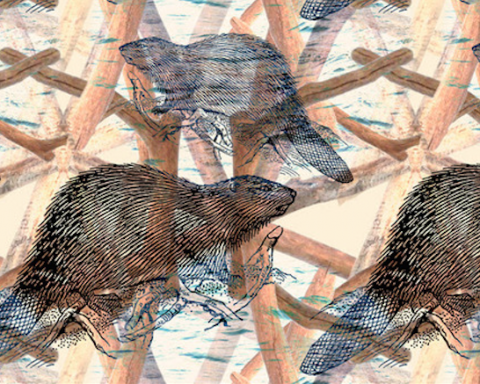
http://en.wikipedia.org/wiki/Bi%C3%A8vre_%28river%29
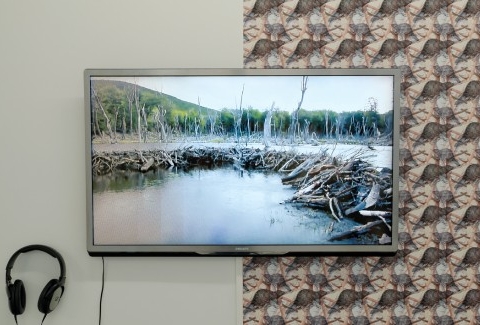
To begin with, the audience was offered a seance of semiology from video images shared by Christy Gast and Laura Ogden, opening in Karunkinka. From this, a series of words, concepts or actors were excerpted and written down on sheets of white paper:
– the hunter, the locals, the beavers, the fallen trees, the philosophy, the useless work, the scientists, the state, the artist, the water, and so on.
After that, we were all invited to participate in a “Family constellation exercise”, a role-playing game of sorts,The replica of a beaver attributed a role to each member of the audience, in turn creating their own representation of constellations.
Each participant was afterwards free to move into another group, to which they though they were closer.
This exercise triggered reflexions, thoughts and discussions on the place of each individual in a global environment. How to think about interconnections or chains of causes and consequences, that make each ecological issue such a complex puzzle?
We heard different views from the participants on how they perceive themselves in the global environment among beavers and forests: some tried to hear, to feel or to experiment with the position of the animal, others emphasized the difference in positions.
We heard for instance that “beavers taste like the wood they eat”.
Other conceptions were more anthropomorphic, perceiving beavers as sculptors, or engineers, whilst envisioning their family, their work, their land.
To conclude this work week session and in an attempt to define the highlights of this collaborative project between artists and scientists, let us (re)consider the following points :
1- Everyone must leave their comfort zone to enhance the exercise of “looking at things differently”.
2- A connection or parallel is discernible between the global ecological situation and the history of colonialism ; these are two entry points from which to understand the current research in post-human geography.
3- And finally, what everyone, no matter from what specific field, can share, is an ability to feel intimately attached to an environment – be it the entire landscape or its components – we can all be touched by a certain wonder, from which can emerge a sense, whether poetic or scientific; we just use different ways to do so.
http://kadist.tumblr.com/post/88585184715/session-at-the-mus%C3%A9um-national-dhistoire
« Beyond the End » est une exposition consacrée à Ensayos, un programme de recherche et de résidence initié en 2010 en Terre de Feu (Chili) par la commissaire d’exposition Camila Marambio. Présenté en parallèle de l’exposition à la Fondation Kadist, “Dans la peau du castor” clôture une semaine d’échanges (présentations, performances, projections) réunissant artistes et chercheurs autour de questions liées à la conservation bio culturelle.
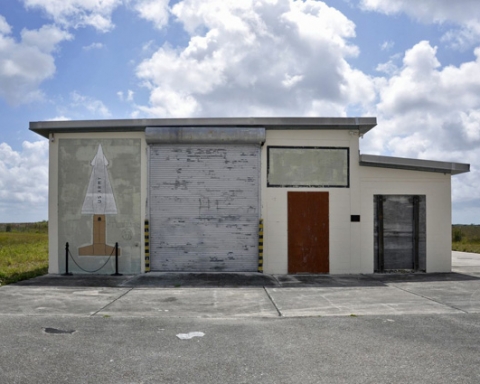
More on ressoure0 at: http://www.ressource0.com/?agenda=dans-la-peau-du-castor-debat-et-etude-de-cas
Consider, for a moment, the hole-in-the-donut: a confectionary absence that signifies a presence, a sort of vortex of meaning, potentially a Rorschach test.
Also the name of a place in the Everglades, the Hole-in-the-Donut (HID) is a 6,600-acre tract of wetlands. Its import, as a haven for destructive, invasive plant species amongst native ones, is not only ecological. The chill of the Cold War lingers there too, where a nuclear missile site once stood on high alert, aimed at Havana.
More on the Hyperallergic website at: http://hyperallergic.com/119452/the-cold-war-in-floridas-wetlands/
A new freestanding sculpture by Inna Babaeva extends her fascination with mass-produced supports; a postcard stand acts as a pedestal for postcards featuring two sets of photographic images. One series of found black & white family snapshots resemble scenes from Jean Luc Godard’s 1965 film “Pierrot Le Fou”. Screenshots from the film along with the family’s photos to create limited edition postcards.
Maureen Cavanaugh’s paintings have a quietly ghost-like quality. Painted with layers of thin washes, the artist achieves a slow opacity that erases and obscures underlying figures. Screen and Table creates an unexpected dialogue with furniture inhabiting the gallery, in a direct nod to Matisse’s 1921 painting Moorish Screen.
William Crump is an abstract painter and astute collagist. Several works will be included from his Spirit Series, which position images of artifacts (such as textiles, arrowheads, baskets, shells) into loose arrangements suggestive of faces. Mr. Crump embraces the power of objects and their ability to symbolize a person, story or ideal, dislocated between time and space.
Jacob Feige, a Philadelphia based painter, uses documents, photographs and audio to enhance the viewer’s experience, reminiscent of museology and its elucidation of obscure artifacts. The paintings – often landscapes – are blurred or obscured, seemingly by a surreal encounter or lens malfunction. Based on a futuristic city that was never built, New City features audio narration by the artist that plays via radio.
Miami-based artist Christy Gast presents a triptych of framed stills from the video We Live Inside the World, whose point of departure is an assertion by a 19th century utopian Florida community that the Earth is a hollow sphere, cradling the entire universe inside. We Live Inside the World documents performative attempts to embody this esoteric paradigm, using inverted cosmological models and pseudo-science.
More on their website at: http://halbromm.com/lost-found-ii/
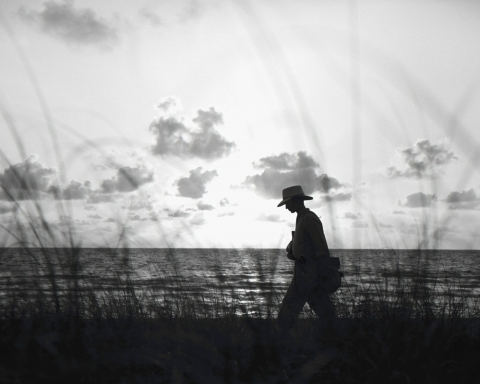
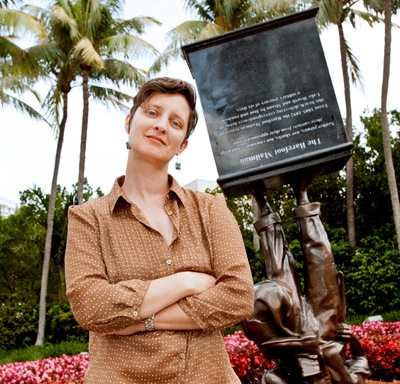
This past weekend, artist Christy Gast unveiled her 12-foot, bronzed fiberglass Self Portrait As The Barefoot Mailman sculpture at Bal Harbour Founder’s Circle as part of the community’s “Unscripted” public art series. The piece nods South Florida’s legendary barefoot mailmen, who walked the route between Palm Beach and Miami in the 1880s, before there were roads and Henry Flagler’s famed railway.
Gast’s submission idea was born when she happened across a historic plaque describing these contracted postmen. As she began to research the topic, she learned that the “Unscripted” sites overlapped with the old delivery route. “The idea of being alone and walking on the beach was really romantic for me,” says Gast. “I wanted to play with that concept.” Play she did: to add a personal touch, Gast used herself as a model (with the help of a high-tech 3D scanner) and turned the piece on its head, literally. “To me, it resembles an hourglass, which is another way of measuring time,” she explains.
More on the Ocean Drive website at: http://oceandrive.com/christy-gast-sculpts-barefoot-mailman
Once upon a time—before electronic mail was even a twinkle in a programmer’s eye—correspondence was delivered by heroic means. As the legend goes: “Neither pirates, nor sharks, nor crocodiles shall keep these carriers from their appointed rounds.” In the case of the iconic seaside U.S Mail carriers in 19th-century South Florida, coined the Barefoot Mailmen, their routed course spanned a 68-mile stretch across the Florida coast—void of roads, railroads, or fresh water for horses. Aside from the 28 miles traversed by rowboat, the rest of the journey was taken with bare feet upon the sand.
More on the Artsy website at: https://www.artsy.net/article/editorial-the-barefoot-mailman-in-3d
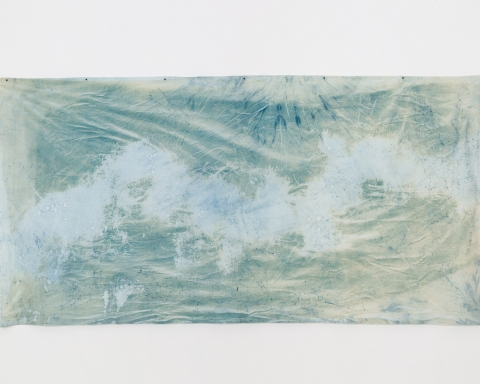
Christy Gast is a Tramp. And by that I don’t mean she’s a floozy, though she does know how to have a good time. I mean it in the sense of a “gentlewoman of the road”—a true adventurer who wanders the defiantly less-traveled roads of the Americas just to see what life is like there; what folks are up to and how foliage changes. Luckily for us she is an artist, transforming those experiences into things, which she shares. Her current exhibition is loose and freewheeling, made on a road trip this summer that looped around the country. Along the way she made cyanotype portraits of specific sites, assembled from the detritus found near bodies of water.
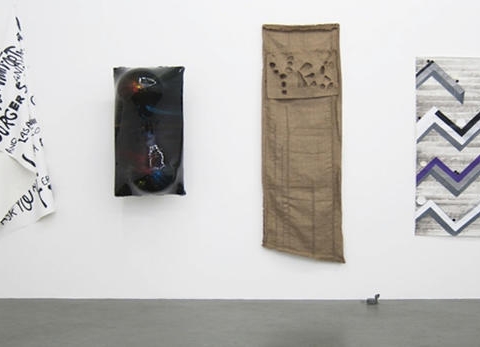
More on the Diet website at: http://gallerydiet.com/2014/09/30/christy-gast-byways/
As laid out by the organizers, this “roving” show of a dozen artists that began in Miami before heading north aims for some conceptual gray area between finished and unfinished work. But mostly, it seems to add a certain tropical ebullience to the notion of process art.
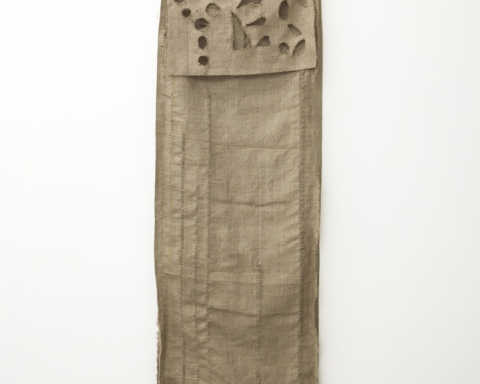
This coöperative gallery, managed by a rotating crew of thirteen, opens its doors to twelve artists based in Miami who favor found objects and a process-oriented approach. Consuelo Castaneda embellishes her zigzagging abstraction with rounds of cotton and makeup sponges; Jorge Pantoja paints moody compositions on DVDs; Sinisa Kukee mounts a bulbous black resin sculpture on milk crates. Language enters the picture in works by Christy Gast, who punctures the word “yes” into a piece of burlap, and by Kerry Phillips, who transforms a “ya” she received in a text message into calligraphy. Through Aug. 26.
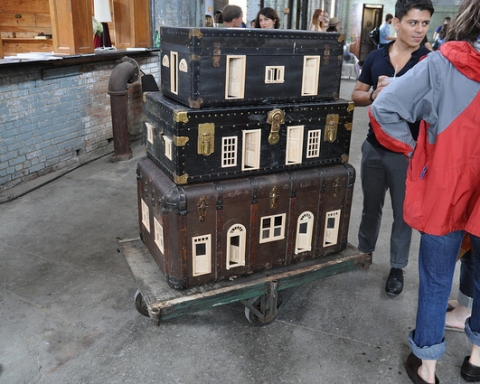
A few of the locals intermingled with the art world of New York City and Miami in the huge Barn-like building of Basilica Hudson on the outskirts of the town where NADA held its 2012 Hudson art fair. The vibe is relaxed — detached from the frenzied energy of New York art gatherings — stirring genuine curiosity about the objects that lay throughout the Main Hall.
Unlike conventional art fairs this fair did not have booth walls to interrupt the space and did not have a mish-mash of work for visitors to try to make sense of. Instead, each gallery was confined to exhibit only one artwork shared the same free flowing smells of damp grass air as their neighbor exhibitors. This open format afforded the 32 artworks on exhibition enough space to be circumnavigated easily, sparking focused curiosity and a encouraging a deeper investigation of each piece. In addition, because Basilica Hudson is a historical building no one is allowed to use the walls, which interrupted a conventional hanging and moved the exhibition quite literally center stage. Many of the artists where challenged to take the opportunity to create an artwork specifically for the occasion, which meant the work for the most part shared in common a consideration of materials within a sculptural or installation format: from Christy Gast‘s burlap flag-like sculpture to Mike Hein’s palm tree in plastic acrylic encasing to Borden Capalino’s wittily titled “Stage Door Johnny” — a Plasticine covered plastic cat box atop an overturned and semi-dismantled chaise. Refreshingly the fair came together as a cohesive exhibition.
More on Hyperallergic at: http://hyperallergic.com/55011/nada-hudson-2012/
Out of Place features ten sculptural wall works constructed almost entirely out of burlap. As a distinct shift in practice for Gast, this new body of work was conceived through an intuitive process of exchanges, meditations, and transformations in and around the artist’s studio. There, claimed objects from various arbitrary sites were manipulated into assemblages, and translated finally into the fibrous cloth. In this process, Gast’s significant skill and background in textiles murmured to the surface — traced from a rural adolescence fashioning her own clothes and experimenting with cloth as a medium in bucolic Ohio. For Gast, burlap is a choice that seemed somehow obvious, its rawness offering a place to begin.
More on the Miami Rail website at: https://miamirail.org/summer-2012/christy-gast-out-of-place/
In 1946, a bizarre cargo shipment stopped over at the Pan American Airlines headquarters in Miami. En route to Tierra del Fuego, the southern most tip of South America, fifty North American Beavers were temporarily housed in a walk-in refrigerator maintained by the airline. The door of the fridge, however, was made of wood.
This is oversight at its worst; Beavers in a prison made of wood.
As Miami-based artist Christy Gast tells this story, she knows it rings with hilarity. The beavers, of course, chewed their way out of the cooler but not to freedom. They ran amok in Pan Am’s offices, causing secretaries to jump on their desktops shrieking in fear. It is a goofy image, and slightly bittersweet, because unbeknownst to anyone at the time, the beavers were not done causing havoc. And still aren’t.
More on the WLRN website at: http://wlrn.org/post/three-miami-thinkers-take-beavers-end-world