
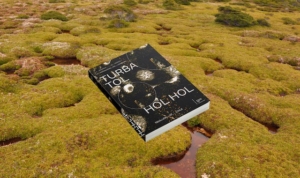
I contributed writing and images to Turba Tol Hol-Hol the book, which is available now. Edited by Carla Macchiavello Cornejo
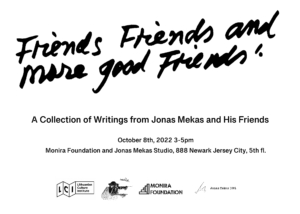
A Collection of Writings / by Jonas Mekas and His Friends EDITED BY: Charity Coleman PRINTED BY: Calipso Press PUBLISHED
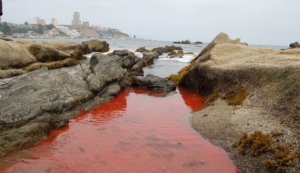
In the inaugural issue of the River Rail there are articles by four Ensayistas: Christy Gast and Bárbara Saavedra, Admiralty Sound Expedition Report
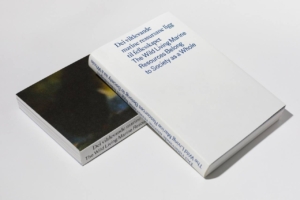
The anthology “The Wild Living Marine Resources Belong to Society as a Whole” contains a wide range of expressions: poems,
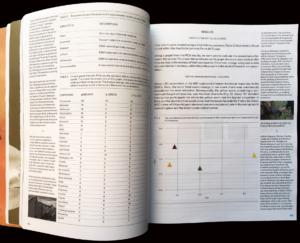
“Dear Enemy: Interspecies Communication through Artisinal Scents,” Pioneer Works Journal, July 2017, pp. 94-109 Co-authored by Christy Gast, Camila Marambio, Giorgia Graells
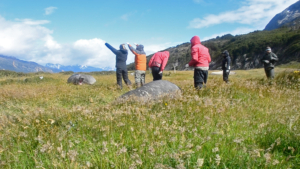
In Tierra del Fuego, where the Atlantic meets the Pacific, land and sea are not so much interwoven as fractured—splintered
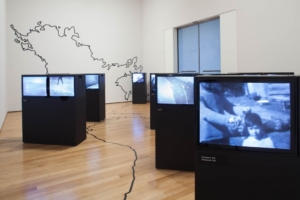
Essay on Juan Downey's Video Trans Américas for Miami Rail
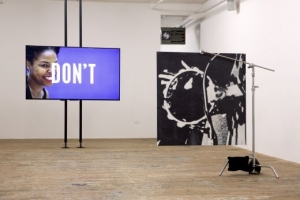
In advance of Martine Syms’s public project Nite Life, which will appear on buses throughout Miami this winter as part
ERNESTO NETO AND THE HUNI KUIN ARU KUXIPA: SACRED SECRET CHRISTY GAST THYSSEN-BOMEMISZA ART CONTEMPORARY, VIENNA JUNE 25–OCTOBER 25, 2015
Flat Rock at the Museum of Contemporary Art, North Miami, is Virginia Overton’s first solo exhibition in an American museum.

I contributed writing and images to Turba Tol Hol-Hol the book, which is available now.

Edited by Carla Macchiavello Cornejo and Camila Marambio Turba Tol Hol-Hol-the book is a compendium of the extensive eco-cultural thought of Latin American and Caribbean authors who center their attention on struggles, ways of doing, and experiences of care from the South.

Read the Book

Ebook downloads here: https://turbatol.org/turba-book.html

PDF of the book here: https://turbatol.org/book/Turba_Tol_Hol-Hol_(eng).pdf

More info in English & Spanish here.

A Collection of Writings / by Jonas Mekas and His Friends

EDITED BY: Charity Coleman

PRINTED BY: Calipso Press

PUBLISHED IN ASSOCIATION WITH: Center for Book Arts

Risograph printed by Calipso Press. Saddle stitch (staple bound). Cover letterpress printed by Anne Muntges.

Contributors: Jonas Mekas, Gabriela Galvan, Christy Gast, Luba Drozd, Nathlie Provosty, Lynne Tillman, Hollis Melton, Sparrow, Masha Godovannaya, Charity Coleman, Bradley Eros, Evan James, Brenda Iijima, Edwin Torres, Will Heinrich.

1 volume : 2 color illustrations ; 20 x 13 cm

In the inaugural issue of the River Rail there are articles by four Ensayistas: Christy Gast and Bárbara Saavedra, Admiralty Sound Expedition Report by with an afterword by Dr. Bárbara Saavedra, Camila Marambio, The Go-Between, and Cecilia Vicuña Con Cón, Chile, 1966 – 2006.

___________

Note from the Publisher:

The River Rail is a bi-annual, free publication that focuses solely on the urgent subject of nature: its beauty, abuse, and changing climate that is gravely affecting every aspect of the planet’s ecosystem, and our lives. An offshoot of the Brooklyn Rail, the idea comes as a response to the Trump administration’s aggressive attack on human rights and equality, cultural knowledge, environmental protection, and scientific methodology based in research and fact.

Current research is showing that water is to our 21st century what oil was to the 20th century. The River Rail raises issues that many of us are not aware of, and proposes some actions. To illustrate, a thermocline is a layer of the ocean where the temperature changes more rapidly with depth, caused by the collision of warm and cold currents; woe be the day when our feelings about the Earth’s conditions remain lukewarm. Building upon a history dating back to over thirty millennia, when our Paleolithic ancestors painted images of bison, horses, and aurochs on irregular cave walls, to the late 1960s when “earth art” was built into site-specific natural environments, to our commitment today to ensure this labor of love and care for the fragility of ecological matters is firm and solid. This augury of ecological concerns and explorations is a new beginning of our collective work in the making.

In solidarity, as ever,
Phong Bui

The anthology “The Wild Living Marine Resources Belong to Society as a Whole” contains a wide range of expressions: poems, essays, photos, articles, manifestos and artworks, all of which relate to our management of natural resources or discuss our fundamental views on nature. The book got its name from Section 2 of the Norwegian Marine Resources Act: The Wild Living Marine Resources Belong to Society as a Whole.

What can laws and management tell us about the relationships we have to nature and to our surroundings? And what role can art play in relation to climate change and environmental issues?

“The Wild Living Marine Resources Belong to Society as a Whole” is a part of Ensayo #4, which is an interdisciplinary project that began in 2015 and deals with management, language, values and identity related to the ocean and the coast in certain parts of Norway and Chile. The goal is to understand, express and manage the big environmental issues we are facing in new and better ways.

The main project Ensayos was founded in Tierra del Fuego in 2011 by curator Camila Marambio.

The publication is supported by Arts Council Norway and Billedkunstnernes vederlagsfond.

Design: David Benski & Laurens Bauer
Edition: 500
ISBN: 978-82-303-3659-5
Published by Randi Nygård and Karolin Tampere as part of Ensayo#4, 2017

The following artists, poets, academics, and fishermen have contributed to the book:

Christy Gast, Geir Tore Holm, Søssa Jørgensen, Amy Franceschini and Futurefarmers, Jahn Petter Johnsen (Norges fiskerihøgskule, UiT), Solveig Bøe (NTNU, Trondheim), Jason Hall-Spencer (Plymouth University), Inger Elisabeth Hansen, Alejandra Mancilla (UiO), Lise Doksæter Sivle (Havforskningsintituttet i Bergen), Paul Wassmann (UiT), Camilla Brattland (UiT), Michelle-Marie Letelier, Georgiana Dobre, Camila Marambio, Camilla Renate Nicolaisen, Maja Nilsen, Munan Øvrelid, Cecilia Vicuña, Erik Solheim (UN Environment Executive Director, UNEP), Kjersti Vetterstad, Georgiana Dobre, Camila Marambio, Sarita Gálvez, Barbara Savedra (Director, Wildlife Conservation Society, Chile), Arne Johan Vetlesen (UiO) og Amy Balkin.

Contributors of the Logbook:
Petter Snekkestad, Kjersti Vetterstad, Georgiana Dobre, Snorre Magnar Solberg, Stefan Mitterer, Karolin Tampere, Martin Lundberg, Christy Gast, Geir Tore Holm, Søssa Jørgensen and Amy Franceschini.

The Logbook is funded by Nordland County and the Municipality of Gildeskål

ISBN: 978-82-303-3759-2
Design: Jaan Evart
Edition: 700

“Dear Enemy: Interspecies Communication through Artisinal Scents,” Pioneer Works Journal, July 2017, pp. 94-109

Co-authored by Christy Gast, Camila Marambio, Giorgia Graells and Derek Corcoran.

Follow this link to view online or download: https://ensayostierradelfuego.net/wp-content/uploads/2023/05/Just_DearEnemy.pdf

In Tierra del Fuego, where the Atlantic meets the Pacific, land and sea are not so much interwoven as fractured—splintered and shattered. At the southern terminus of the Andes, it is as if the mountains are using the remainder of their geological force to dive out of the deep and frigid sea.

Originally published in the Summer 2016 edition of the Miami Rail.


In advance of Martine Syms’s public project Nite Life, which will appear on buses throughout Miami this winter as part of Locust Projects’ Art on the Move program, Christy Gast met with her in her Los Angeles studio to discuss her research and creative practice. Syms, who considers herself a conceptual entrepreneur, has a background in graphic design and media art. She founded the small press Dominica, which publishes essays and poetry, and her influential text “The Mundane Afrofuturist Manifesto” was published by Rhizome in 2013. Her first solo exhibition was held at Bridget Donahue gallery in New York this past fall.

CHRISTY GAST (MIAMI RAIL): Let’s begin in Overtown, specifically at the corner of NW 10th Street and 2nd Avenue. You’re creating a series of posters for the backs of buses and bus shelters that point to that corner, the former home of the Harlem Square Club, which was a Chitlin’ Circuit venue where black musicians performed during the segregation era. Your source material includes posters designed by Clyde Killens, a promoter who brought acts like Patti LaBelle, Aretha Franklin, and B. B. King to Overtown.

MARTINE SYMS: The project is a continuation of my commission for the O, Miami Poetry Festival last April. I’m using the same title, Nite Life, which is the name of an Overtown entertainment newspaper from that era. A lot of my works deal with the idea of distribution shaping the form of work. My project for the New Museum Triennial was about the sitcom format, a narrative style and commercial constraint that produces a particular kind of storytelling. I also wrote a book-length essay about the film network that corresponded to the Chitlin’ Circuit, thinking about how those modes of circulation influence the form of the work that gets produced. For O, Miami, I focused on Sam Cooke’s album Live at the Harlem Square Club, which has been a reference point for me personally. It’s an album that I listen to a lot, but I really became fascinated with its history because it was shelved for twenty years. It was recorded in 1963 and not released until 1985. The recording is really raw. The two sound engineers were actually in the audience, so the recording really captures that time and place.

My interest in the album, and in what shifted socially in those twenty years, was my starting point. I used the transcriptions of Cooke’s onstage banter to create a poem, and there was a corresponding performance. As I was researching for that in the Black Archives at HistoryMiami, Clyde Killens kept coming up as a prominent figure. He was a club promoter at multiple clubs. Reading transcripts of interviews with him, you see that he was really a big part of why certain acts were coming to Miami. He was bringing the acts, and he took full responsibility for designing ads for them. His vernacular advertising style is very interesting to me, and I decided to continue working with it when Franklin Sirmans, who is guest curating the project for Locust Projects, approached me. I thought I would continue that site-specific line of inquiry. I’m referring to the advertisements as source material, and I’m reconstituting that and creating more, using the same typography to think about the way these identities circulated. Now they’ll be in proper advertising spaces, which is an interesting continuation of this circulation.

RAIL: There’s a lot to unpack, but I want to start with the Chitlin’ Circuit, venues during the segregation area where African American performers would perform in black communities.

SYMS: The Chitlin’ Circuit arose from hyper-segregated modes of distribution, which were distinct until the 1960s. In film, there was the Jewish market and the black market, which operated within the ghettos of those communities. So if you were making films for a Jewish audience, there was a set of venues where you would screen them. A lot of vaudeville comes out of the parallel histories of black and Jewish entertainment communities. The Chitlin’ Circuit is essentially like a black vaudeville network. There were specific movie theaters, specific venues, many of which are still around. The Apollo Theater in Harlem is probably the most famous one.

The movie theaters actually didn’t fare aswell as the music venues after integration in film started. Venues primarily serving black audiences didn’t have any money anymore. Which is what happened in a lot of places, like in Overtown. A lot of the people I talked to there, including Willie Clarke from Deep City Records, as well as Clyde Killens, said that integration partially took the economic engine out of the neighborhood. So that’s something that’s bittersweet. On the one hand, obviously racism has so many disastrous and negative effects. But because of it, you had businesses that were serving that community, were part of that community, and money was circulating within that community. The second that you didn’t have that restriction anymore, those businesses were at a disadvantage.

RAIL: In an interview I read with Killens, he spoke obliquely about what happened in those twenty years after official segregation was ended, but didn’t name specific events. To me, the era is bookended by two events. In the 1960s, I-95 was built in the middle of Overtown, forcing homeowners out and fracturing the community. In 1980, residents rioted after an all-white jury acquitted four Miami police officers in the beating death of Arthur McDuffie. These events provide a cultural background for the art that was being made at that time. During those twenty years, a lot of entertainers made the shift from the Chitlin’ Circuit to television. Redd Foxx, for example, whose sitcom Sanford and Son was broadcast in the 1980s.

SYMS: Yeah, Redd Foxx was a Moms Mabley protégé. He came very specifically from the black vaudeville tradition, but really got famous because he was recording party records. That popularity led to Sanford and Son, which I think he started in ’74. He wanted to translate that intimate and vernacular style of comedy to television. Richard Pryor was also a writer on Sanford and Son, as was Ilunga Adell, who later made the show My Brother and Me, which I watched on Nickelodeon growing up. Adell started with the Black Arts Movement as a playwright. So those were the kinds of writers that Redd Foxx hired to be on the show. He also had so many guest stars, from LaWanda Page who played his sister-in-law on the show, to various entertainers and guest stars who he knew from his vaudeville era.

There’s this great Killens billboard that’s just all of Redd Foxx’s party record covers. “Redd Foxx!” “Saturday/Sunday!” He is an interesting figure because he bridged two different generations of entertainment. He played those Chitlin’ Circuit clubs, and the touring schedule was really brutal. Even someone like Sam Cooke, who at that time was a big, big star, was still playing these clubs every single night and it was not that glamorous. That was the kind of showmanship they were used to.

RAIL: They lived to perform.

SYMS: Yeah, it was just constant performances from one place to the other, moving from one black community and then driving to the next one, in a time when they couldn’t really stop in other places. There were a lot of hotels and gas stations they couldn’t go to.

RAIL: And there was a lot of in-home family lodging because so many hotels were off-limits to African Americans. At that time, both black and white musicians would play late-night shows at Chitlin’ Circuit venues after shows in, say, Miami Beach. Performers from the Rat Pack would hang out and play all night at clubs in Overtown and Liberty City.

SYMS: Exactly. It was a really dynamic moment. Miami has such a great entertainment history that originates in Overtown in that mid-century moment.

This is part of why I’m drawn to it. A lot of these influences, other popular media, intersected at that moment.

RAIL: One of the bus lines that will carry your posters originates in downtown Miami at the Government Center, where you researched in the archives. A little farther north it stops at the corner where the Harlem Square Club was, and then follows the trajectory of the riots up through Wynwood, and also the trajectory of where people moved after segregation—to neighborhoods farther north. It’s interesting to place that design-based expression of a historical moment on a geographic trajectory.

SYMS: That’s why I wanted them to start in Overtown and move outward in a similar way that a lot of the cultural expression was working. This was a place, like you’re saying, where you would find the craziest kind of combinations, like four giant stars all hanging out at this one nightclub together. I think that shows what the period was like, fruitful creative expression. I’m interested in how that circulated and, like you’re saying, what happened in the ensuing twenty years, between 1965 and ’85.

I usually like to bracket work between two time frames. My background is in film; I approach a lot of things from that perspective. Specifically, I like the idea that the project of film is moving through time and space. Using these origin points to think about what’s been traversed in that time and that is happening now, I’m using it as more source material to draw another relationship from them to me now.

RAIL: Back to the source material, Killens’s posters: black background, simplified portraits, the focus on text. Cropping is a strategy you use a lot in your work. Whether it’s sound, images, photos, or design elements, the way that they’re cropped is really important. How do these elements come together in Nite Life?

SYMS: Cropping has an aesthetic parallel in the idea of “close reading.” I’m isolating different elements to make an extreme focal point. Typographically, I’ve been thinking about the designer Rob Giampietro’s essay “Stereotypography,” in which he traces the lineage of two typefaces, Neuland and Lithos, which are so often used on, like, Native Sun remakes, the Lion King, or sitcoms like Martin and My Brother and Me.

RAIL: Those fonts are used as a generic marker of “ethnic.” Neuland reminds me of Comic Sans.

SYMS: Yeah, it’s really not the nicest looking font. It doesn’t look sophisticated, and I think that’s the point, it looks kind of primitive. So I’m using that font again, combined with another typeface that is based on the heading for Nite Life magazine. I pulled text from Killens’s billboards, which always have some funny descriptions like “brilliant pianist and singer straight from the village gates, New York.” So I’m combining these phrases into “word poems”—and I’m using the word “poem,” but I’m using that fairly loosely, because I don’t really know much about poetry. I’m using that word bank to write new text and take different elements from his designs, so I think that’s where the cropping comes into play. I’m isolating elements that I’m drawn to, the stroke of one of the borders, these phrases, the style of portraiture. It’s really thinking about looking as another way of reading.

RAIL: You’ve recently had your first solo exhibition in a gallery context at Bridget Donahue in New York, and I saw some things happening there that are really condensed in the Overtown project. Cropping was important, as was the way you drew from language, both with words and gestures, to build figures. I saw those sculptures as bodies that express how people are represented through media, specifically black people.

SYMS: I would say, for starters, it’s scary to call them sculptures, but I do think I’m extremely interested in the figure and I’m fully owning that.

Part of my thinking about the show was that I wanted it to look like a film set, so as I was constructing those I was just thinking a lot about this idea of character, which I built on in the Notes on Gesture film. It’s based on an essay by Giorgio Agamben, “Notes on Gesture,” about film as a place that we store our gestures. I disagree, but I’m interested in the idea that movement and gesture are a core language of cinema. I was thinking of this in combination with a series of early Edison films that feature black women moving through the city, and thinking about this idea of subjectivity of the self and what constitutes that, especially in popular media, which is my primary subject matter. I just think it remains a discursive form where ideas and values circulate. I asked myself, “How can I create a character in gesture, and what does that person sound like and look like?” I began researching acting techniques and found the book Chirologia: Or the Natural Language of the Hand by John Bulwer, which was published in 1644. It’s a guide of paralinguistic gestures in Shakespearean theater, which were rigidly coded to have certain effects. There was an emotional coding to it. The film creates an analogue to that, focusing on a black female body.

RAIL: The woodcuts in Chirologia encapsulate gestures with the most simplified image of a hand imaginable, which resonates with the big print of the hand with the tambourine in your Notes on Gesture film in the installation. The woman in that film performs short little gestures over and over in front of a bright purple screen: a short inhalation, a hand gesture, a head tilt and laugh. Elsewhere in the space, a bright purple screen leans against the wall. It works as a minimalist sculpture, nodding to Charles Ray, but it also refers to the green or blue screens used for chroma keying. I thought about something that Coco Fusco said when she was putting together the ICP triennial, that photographic film wasn’t developed to or ever really capable of fully recording black skin. All those references were in that piece for me, and I wonder if that’s what was in it for you?

SYMS: Yes, I was definitely thinking about white balance, proper exposure, techniques for creating the correct image. I’m interested in shifting ideas of what that correct image is, and even what the right frame of reference of that is. Even with the colors. I began to use purple in relationship to Alice Walker’s book The Color Purple and Oprah’s film adaptation of it. But then in a conversation with Noah Davis, a painter and friend who recently passed away, he said, “I’m so happy to see you using purple because I always use it for stuff.” And I said, “Purple is like the black person’s Yves Klein Blue.”

RAIL: Purple has such an interesting history. In the Roman era it was only available by milking the gland of a murex sea mollusk, and since then it’s been associated with wealth, power, and exclusivity.

SYMS: In addition to that, in Julie Dash’s film Daughters of the Dust she also connects it to indigo harvesting. A motif in the film is everyone’s hands stained purple from the crops.

RAIL: The production of both murex and indigo require super visceral, physical labor that smells bad and stains the skin.

SYMS: Exactly. Conversely, in the book it operates as an indicator of—I think the quote is something to the effect of—“Purple is like God trying to show off,” so it indicates the supernatural in a secular space.

So I think it’s really like a confluence of those ideas for me, a stain that’s also this royal color. It’s like Arthur Jafa says about things that are “scuffed.” He has this idea of black visual inclination, one of them is the idea of things being scuffed.

RAIL: That’s interesting in relation to Michael Taussig’s book What Color Is the Sacred?, where he pulls each color from the spectrum and looks at how it figures into the realm of the sacred, but it’s missing the textural aspect.

SYMS: Everything is scuffed! Everything should be scuffed!

RAIL: Circling back to language and expression, Bridget Donahue was telling me that when people come into the gallery they say things like, “So, tell me about the color purple,” or “So, tell me about that Black Panther.” Those works manipulate the viewer into talking about things that aren’t part of the everyday discourse of a contemporary art gallery.

SYMS: It is really gratifying to me when people utter the phrase “the color purple” in the gallery, it’s like a direct reference to that book, which maybe they read or maybe they haven’t read. When I was shipping the work, one of the shippers who was helping me said, “Look, it’s a Black Panther.” It’s a linguistic play, an object that is a text, an object that does things that text does, like refer and describe. I’m interested in that, and I’m also asking, “Who is the art viewer?” There’s the assumption that the viewer and oftentimes the artist is a white male, or a white person. I’ve been assuming that my viewer is not that. Especially with this work, I think. I’m talking to a black viewer in the way that, maybe, Clyde Killens was. He was talking to more than that, but that could be his presumed audience and I don’t think it’s a limitation. It’s a way of operating. In the same way that we were talking about white balance in photography, as if you’re exposing for a different skin color.

RAIL: Black balance!

SYMS: Yeah! Black balance, it gives you a different image, you know? It relates to this idea of this black visual inclination. What does that aesthetically look like in a formal sense? Not even just conceptually, but what are some formal decisions that can be made in exploring that idea?

Christy Gast is an artist whose work across mediums reflects her interest in issues of economics and the environment.

Martine Syms with Christy Gast

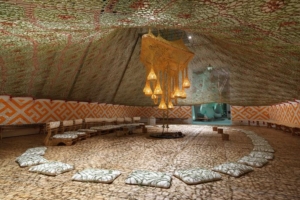
ERNESTO NETO AND THE HUNI KUIN ARU KUXIPA: SACRED SECRET

CHRISTY GAST

THYSSEN-BOMEMISZA ART CONTEMPORARY, VIENNA

JUNE 25–OCTOBER 25, 2015

As dusk descended on a cool summer night in Vienna’s baroque Augarten park, an extraordinary seminar commenced on the lawn adjacent to Thyssen-Bornemisza Art Contemporary. The gallery was exhibiting work from a three-location retrospective of Ernesto Neto, the Brazilian artist known for weblike installations of stretched nylon filled with saffron, seeds, and other fragrant matter. As attendees filled benches and blankets on the lawn, a group of presenters filed past Carsten Höller’s resinous blow-up of a psychedelic mushroom and onto a wooden stage. Resplendent in traditional woven robes and iridescent macaw feather headdresses, this delegation of Huni Kuin pajes (aritsts and plant healers) from the Brazilian rain forest were Neto’s collaborators, and they had come to share their knowledge of Amazonian plant medicine with the Western world.

The reader should be forgiven a momentary discomfort with the specter of indigenous people on stage in manicured gardens for “educational purposes,” as it has been practiced since the dawn of the colonial era with disastrous consequences for those on view. Pocahontas was presented before the British monarchy in the sixteenth century and did not live through the return passage; Ota Benga, taken from the Belgian Congo in 1904, was presented in a primate enclosure at the Bronx Zoo. He died by his own hand ten years later.

However, this evening in Vienna, nine Huni Kuin took the stage with an assemblage of presenters from several nations and disciplines, and one by one began matter-of-factly to relate a series of recipes for physiological and spiritual healing using Amazonian plants, including ayahuasca, a DMT-containing brew known for its hallucinogenic effect. They were there as artists, healers, and experts, and this was the audience’s introduction to the new Livro da Cura (Book of Healing), an encyclopedia of plant-based medicine that was published last year in Portugese and the Haxta Kui language and is now being released in English. Organized by a team from the Botanical Garden of Rio de Janeiro, who left field notebooks at secluded settlements along the Jordao River where the Huni Kuin annotated and illustrated each cure as it was performed, the Livro da Cura both shares and protects this spiritual and medical knowledge as the community’s intellectual property.

The Huni Kuin’s decision that now is the time to protect their right to live in and with the forest, by publicly claiming the use and knowledge of specific plants’ chemical compounds as their cultural patrimony, is in line with recent attempts to codify and protect indigenous knowledge as intellectual property. Written and published in a standardized form, these oral traditions become a tangible commodity, a book that stakes claim and gives value to forest-based knowledge in a form that can both limit deforestation and require that credit and compensation be given when those plant compounds are transformed into conventional phar- maceutical treatments.

Sharing the knowledge contained in the Livro da Cura is also the central focus of the installations inside of Thyssen-Bornemisza’s three large galleries. Neto is known for works that envelop the viewer in a way that is indebted to his Brazilian compatriot Lygia Clark, whose Máscaras sensoriais are experienced individually from the inside out, and to Ilya and Emilia Kabakov, whose notion of “total installation” thrusts the viewer into an artwork’s pictorial space. Here Neto moves beyond the Western canon, presenting a major new installation produced in collaboration with the pajés from Rio Jordao.

The exhibition is anchored by CanoeKeneJaguarPataLampLight (2015), a dimly lit ritualistic space in a large central gallery that combines Neto’s biomorphic forms with the architectural impact of a spiritual center. A rooflike structure of crocheted nylon is suspended from the ceiling, arching down gracefully from a central chimney form. Beneath the chimney hangs a bulbous netted chandelier, which meets a marble altar below via a ladder of snakes. The low light filtering through the netted roof brings to mind a gothic cathedral or a dense forest—and, in fact, Neto and his collaborators are making use of the space with a series of events throughout the summer. By inviting social interaction both within the exhibition and around its central ideas, Neto and the Huni Kuin offer the viewer the chance to absorb the raison d’être for the work itself, a cultural and spiritual forest-based literacy that can only be unlocked through a focused accretion of time and knowledge.

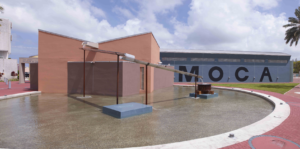
Flat Rock at the Museum of Contemporary Art, North Miami, is Virginia Overton’s first solo exhibition in an American museum. The new freestanding sculptures that Overton created for the show are tenuous yet forceful assemblages of materials the artist encountered around Miami and on site at the museum. The exhibition begins with a large-scale fountain that Overton created for the museum’s pond. In the gallery, she addressed the existing architecture by arranging long planks of lumber to create two parallel lean-to walls; this rudimentary architectural device carves out a long passageway that viewers must navigate before entering a diagonally warped exhibition space.Christy Gast, interviewing Overton for The Miami Rail, is an artist whose work across media reflects her interest in issues of economics and the environment, and the role of content in giving meaning to the experience and form of the work. She met with Overton and MOCA Interim Director and Chief Curator Alex Gartenfeld to discuss the artist’s evolving process, site-specificity and the problematic of the “vernacular.”

CHRISTY GAST (RAIL): I would like to begin with the first piece that visitors, or passersby for that matter, will encounter, the fountain (Untitled, 2014). You have reworked the existing spout and pond in the museum’s plaza, using infrastructural or construction materials that look like they were excavated from the building’s inner workings, in a way that is both functional and sculptural—or anti-functional, and even decorative.

VIRGINIA OVERTON: My work involves an examination of the nature of the commission, and the space—finding the easiest way to get from here to there. I responded immediately to the fountain outside. The two concrete pads in the pond had not been used in years, which Alex and I thought was a shame. In my research I found that the pads originally had trees in them, and formed a grid with the palm trees on the museum’s lawn. The steel hopper at the end, resting on one of the pads, is one of the first things that I saw in Miami when I came to do site visits.

RAIL: I noticed the hopper says “Dade,” and has some other numbers or information written on it. Clearly you sourced it here in Miami-Dade County, but what does that inscription indicate?

OVERTON: The number indicates its weight: 501 pounds. There are hundreds of these steel hoppers at metal-recycling businesses along the Miami River corridor. They use these hoppers to separate metals, moving them around with forklifts. They were originally used for shipping airplane engines. The guy who sold it to us said it was 30 or so years old and they really don’t like to get rid of them. They use them and use them and use them until they are totally mangled. So it took some finagling to get them to relinquish one of these objects.

The hopper was the jumping-off point for the fountain. Then the next step was finding materials that would do the job—transfer water from here to there. Using aluminum for the troughs made sense because it’s somewhat lightweight, fairly inexpensive and easy to bend. It came in flat sheets; I just had it cut in half and then bent on a cold roller.

ALEX GARTENFELD: This issue of functionality is operative. Christy, you mentioned the tension between supposedly functional construction material and the decorativeness of sculpture. Virginia never necessarily absolves any materials of their functionality. All of her structures conscientiously deconstruct the notion of the decorative. In terms of the fountain, functionality manifests dually. The work perpetuates the transfer of water, extending the original purpose of the pond’s spout in an elaborately obvious way. Second is, I hate to call it a social aspect, but an architectural aspect of how the work animates and transforms the space.

That effort recurs in the display apparatus that creates the main gallery—Virginia’s lean-to’s. Formally, the diagonal room is both a strong and tentative type of room, and frames the presentation of these discrete objects.

140416A-46121

Virginia Overton’s Untitled (lean-to-South)(left) and Untitled (Moca’s rollgate fashioned into a lightbox). Photo courtesy of Daniel Portnoy

RAIL: Like the fountain, the works in the main gallery address circulation and movement. For one, the lean-to sculpture creates a darkened hallway that forces visitors forward into the gallery and past the museum’s architecture. Internally, the works seems to point to one another. That happens with the fountain as well—each line seems to point as it moves the water forward.OVERTON: Creating the lean-to is my way of structuring the way I add material to the space, using elements of the architecture that exist and letting them lead the way. At MOCA these guidelines were the Unistrut, a lowered ceiling device that the lighting rigs into. And I bring in the materials that I am familiar with in order to create a new environment while exaggerating the inherent qualities of the space. The materials serve a particular purpose now, in this installation. Later, they’ll perhaps come apart and turn into another thing. The materials themselves have a life cycle.

RAIL: Which relates to why I wanted to start at the fountain—because as you said, these objects came via the river and they were going to leave via the river and the circularity of that process is mirrored in the work. Your concentration on infrastructure is very local to the site of the museum and its specific architecture. For instance, you have created a light box, a big white scrim stretched over a portal of an existing metal roll gate, which is typically closed during an exhibition. The piece completely transforms the way the light works in the space. It filters the intense Miami sun down to a cool ethereal glow.OVERTON: The windows in the exhibition spaces were covered up for a long time. Part of the process of the show was to pay attention to architectural details and uncover a lot of things that had been hidden. When I realized that there was a roll gate in the space I was working in, I wanted to engage it somehow. I’ve made other lightboxes in the backs of pickup trucks by stretching tarps around stretchers mounted to the rim of the truck bed and lighting them from within. Using this opening to make a lightbox without electricity was a nice way to extenuate the natural light that comes through the windows.

GARTENFELD: One of the challenges for Virginia in putting together this show was figuring out how to unify different parts of the space, which are very irregular in terms of the architectural floor plan. MOCA’s building is a Gwathmey Siegel building from the mid-90s—it’s very postmodern, with its curves, niches, asymmetry and use of vernacular materials. Virginia forces an examination of circulation in the space that extends to visitors’ movement between the internal courtyard and the gallery—the bifurcation of inside and outside, which is literally addressed in this piece. It’s the first time that Virginia has created such an inset lightbox.

We joke that this work is an anti-Turrell, because it is possessed of intense and even quite varied experiences of light but at the same time it’s self-reflexive, anti-spectacular, oriented in sensual experience. Obviously Virginia’s approach contrasts with generations of far more macho, far more produced light experiences. This is more natural and more open-ended.

RAIL: The lightbox is interesting because it operates visually, as a white space and a void, but it has a voice, allowing sounds from the museum’s courtyard to filter in.

140429A-46924

Installation view of MOCA’s main gallery

OVERTON: Engaging more than one sense is of interest to me—for instance using wood that has a strong scent or water elements that have sound. Entering the show you immediately walk through a corridor that seems empty, but the light, sound, and changing shape of the space—all of these things make you more aware of where you are, of being in the space and in the moment.RAIL: The work in your show at MOCA is site-specific in that it depends on the space for its structure and is largely made with materials that you collected here in Miami. When we met last week you mentioned you’d been spending a lot of time in the recycling centers on 79th Street and other thrift stores and flea markets.

OVERTON: I really like to immerse myself in the situation so I’ve visited a number of times. I’ve gone on these scouting trips with various people from the museum, including Alex, to all kinds of shops and recycling places, but also just getting familiar with the city and spending time in the museum itself in different states—seeing other shows and seeing it in transition from the last show that was before me to my show and then when it was totally ready. Creating a mental inventory of all these things—materials, space and ideas—gets my mind wrapped around the process. I studied the floor plan for months in advance, carrying it around, arranging the space in my own head.

GARTENFELD: One very specific feature of Virginia’s work is that she doesn’t have a signature style but rather a signature mode of production. A benchmark of her practice has been her concentration on the time and the site of production. Focusing on the exhibition period is important, and a really interesting way for her to investigate issues of an artist’s work. But Virginia intervenes in the assumption that all the work is made on-site and thus spontaneous, or somehow authentic. In turns out she very conscientiously revisited various tropes from her work—the lightbox, the fan, the lean-to or the suspended triangle—which she installed in the museum as a playful tentative mini-survey, as opposed to some kind of authoritative retrospective.

OVERTON: I would talk about the installation period as a chance for me to experiment using materials—using familiar materials but in a new way, or employing new materials in ways that I’m familiar using them. It helps me push my practice and try things and really use an installation as a chance to explore the way that I make work. That said, I am conscious that working during installation is not the only way to work, and needs to remain in flux. I make plenty of work in the studio.

140416A-46130

Virginia Overton, Untitled (Good Year), 2014. Tractor tire, wood, car battery, inverter, white-noise machine. 57 x 57 x 57 inches. Photo courtesy of Daniel Portnoy.

RAIL: A lot of your work involves precariously stacked, leaned or suspended materials creating structures that depend in part on the architecture of the exhibition space for their structure. They seem unstable, one false move and all the pieces could fall to the floor with a powerful racket, yet they are often monumental in scale. Some refer to this tension as “poetic.” I wonder what that means.GARTENFELD: The work is also very physical and even menacing—about to snap.

OVERTON: Yeah, the fan, for instance, can swing wildly at times and we dealt with how to keep it from being too menacing.

GARTENFELD: Christy, as you mentioned, Virginia’s sculpture takes a particular deconstructive approach to monumentality. That is to say it can be very large but also very fragile, and more importantly, that it seems to speak the language of meaning and authority, but delivers something quite different. What I would offer is that poetic is perhaps a misnomer inasmuch as the work isn’t really about language. There’s a syntax, I think, to this exhibition layout, because it engages Virginia’s history of reusing materials and tropes from her own work. But there isn’t a defined system internal to the work that helps to make meaning or form.

RAIL: I have noticed that a lot of reviews of your work jump from Donald Judd to Eva Hesse, whereas I would make a connection to Bill Bollinger. I wonder how you insert yourself into this type of lineage.

OVERTON: I don’t. I like to float around. Obviously I’m thinking about all of these things. But for the same reason the work is untitled. It makes more sense to leave things open-ended.

GARTENFELD: Obviously the issue of gender relates to the history of modernist form. And Virginia’s work typically undermines the tendency to muscularity typically associated with minimalist sculpture. She creates the same confusion in a discussion of “vernacular.”

RAIL: Virginia, you grew up on a farm, as did I, which brings to mind Anna Chave’s essay “Minimalism and Biography.” I recognize some of the gestures in your work as a reflection of an economy of means that you find in an agrarian environment. Materials are reused over and over again, not in a particularly aesthetic way, but in a way that is functionally creative. Could you talk about the farm and how it influences the way you used materials?

OVERTON: When you’re on the farm you use what is on-hand to take care of problems that come up. If a fence is broken you use what you have. If you don’t have fencing you use rope or barbed wire that’s cut off, or whatever. Often I moved different parts from various sculptures to other ones, made things that didn’t end up in the show. Although it’s not exactly like fixing a fence…

140429A-46915

Virginia Overton, Untitled (MOCA, Nort Miami), 2014. Painted aluminum, acrylic, electric wiring, 12 x 96 x 6 inches. Photo courtesy of Daniel Portnoy.

RAIL: Because it doesn’t have to keep the cow in.OVERTON: Maybe it has to keep the cow interested.

GARTENFELD: Virginia is very conscious of the presumption about what it means to use vernacular material. That type of terminology is problematic. She really plays with the biographical references that you might use in order to decipher this work. To use the title of this show, Flat Rock, as an example. It was prompted by having to pick a title for the show. Virginia’s initial recourse in terms of picking a title was a rock on her family’s farm in Tennessee. Although, that doesn’t necessarily suggest…

RAIL: …That all the pieces in the show are exactly referencing a part of the biography.

GARTENFELD: It’s being referenced for Virginia, but not for anyone else. Nobody knows this rock, nobody cares about this rock. It is a dumb object. And as this show evolved, Flat Rock came to mean instead the floor. It came to indicate Virginia’s relationship to space, particularly and generally.

OVERTON: The title was a starting point. As was the lightbox that reads MOCA, North Miami. That’s the only piece that I had fabricated and sent down before the show. This was the fourth in a series of signs that I have made for institutional shows. They give me a point from which to begin. I worked every day, all day long, moving things around, trying things. The wood was in a hundred different places; it was like a CrossFit gym in here with the crew working. Especially once I brought the tractor tire in. You choose an anchor and the process moves from that point forward until it’s done.