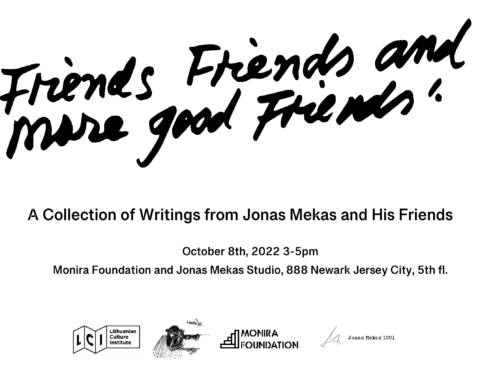
A collection of writings from Jonas Mekas and his friends. Reading on October 8 from 3-5pm at Mana Contemporary on the 5th floor, book will be available.
Accessibility info: Mana Contemporary has a wheelchair accessible entrance on the west side of the building. Service dogs are welcome. There are all gender bathrooms and ADA compliant bathrooms are available on floors 2, 4, 5, and 6. All floors are accessible via the elevator.
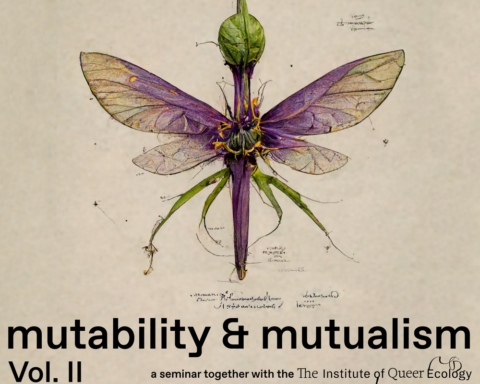
I’ll be presenting on solo and collective work as part of this seminar hosted by the Institute for Post Natural Studies and the Institute for Queer Ecology during the fall of 2022. The speakers in this seminar series will consider the influence of mutability and mutualism on their work in the fields of visual art, evolutionary biology, biodiversity, environmental activism, music, ecology, and queer theory.
More and registration here.
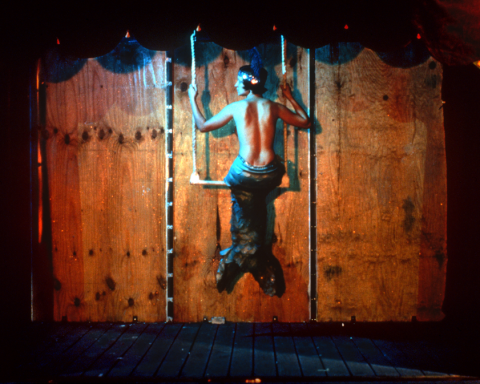
Jarrett Earnest’s essay about my early work with Cloud Seeding Circus is out now in the journal public: Vol. 33 Issue 65, which is also available as a gorgeous hardcover book entitled Devotion: Today’s Future Becomes Tomorrow’s Archive.
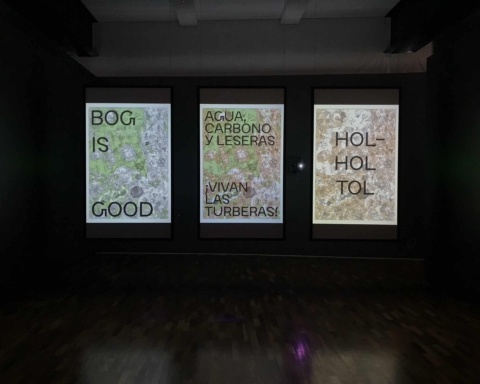
Works that are a part of Ensayos ongoing inquiry into peatland protection can currently be experienced at University of Queensland Art Museum (Brisbane, Australia) as a part of a group exhibition Oceanic Thinking (19 July–17 December 2022). Ensayos works, including posters, scents and audio are exhibited alongside artworks by Amrita Hepi, Madison Bycroft and Angela Tiatia. The exhibition and associated programming challenges visitors to think together with the liquid, vast, biodiverse and non-binary spaces of the ocean to explore the legacies of the past while speculating together on our collective future.
Dr. Lisa Blackmore, Senior Lecturer in Art History and Interdisciplinary Studies, Director of Global Studies & Latin American Studies, School of Philosophy and Art History/Interdisciplinary Studies Centre at Essex University has just published an article in the Journal of Latin American Cultural Studies that considers Camila Marambio’s and my early Ensayos projects about beavers in Tierra del Fuego. The PDF is available here.
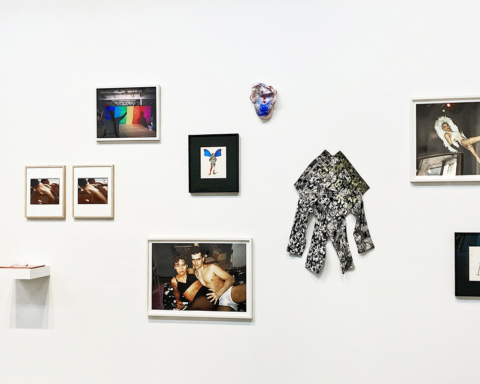
Olga Korper Gallery is pleased to present The Formless Body, curated by Jarrett Earnest. On view from June 4-July 2, 2022, the exhibition invites artists, poets, scholars, and archivists to reflect on the process and materiality of archival work, and their dedication to the stories that archives enable. The focus was on the artistic, intellectual, emotional and spiritual labor itself, attending to the complex problems of queer life in the wake of the AIDS crisis.
The exhibition is the result of an invitation from artist Christine Davis to edit an issue of the journal she co-founded in 1986, PUBLIC: Art/Culture/Ideas. PUBLIC 65—DEVOTION: Today’s Archive is Tomorrow’s Future (2022), simultaneously published as a hardcover book, brings together art, ephemera, scholarship and recollections around the particular practices of queer archival work.
To mark this publication, the exhibition The Formless Body extends those accounts into space, showing important and rarely exhibited artworks by Ching Ho Ching (1946-1989), Darrel Ellis (1958-1992), Robert Flack (1957-2003) Âhasiw Maskêgon-Iskwêw, (1958-2006) along with work by other artists who engage these lineages, like Adrian Stimson’s 2012 re-enactment of Âhasiw Maskêgon-Iskwêw 1992 performance White Shame, and Matthew Leifheit’s photographs of the relics and sites of queer history. The exhibition includes new and historical paintings, sculpture, photographs and time-based media, equally pairing Canadians with artists from the US. The subject of the exhibition is not just the body but the spirit, the presence of the dead, and the transcendence of death, through form.
An attention to the historical importance of ephemera is furthered by a newly created suite of artist’s postcards, funded by Partners In Art, which extend the publication and exhibition beyond their own boundaries, allowing them to proliferate these stories into the world and future archives.
ARTISTS:
Stephen Andrews, Ching Ho Cheng, Alexandra Chowaniec, Christine Davis, Kalale Dalton-Lutale, Darrel Ellis, Robert Flack, Josh T. Franco, Christy Gast, Leonie Guyer, Simone Kearney, Matthew Leifheit, Ian Lewandowski, Âhasiw Maskêgon-Iskwêw, Jamie Ross, Cason Sharpe, Linda Simpson, Adrian Stimson, Tim Whiten
Christy Gast’s research project “Fens & Friends” has been awarded a 2022 NYSCA Support for Artists award. These grants showcases the power of the individual by enabling them to successfully realize their visions. NYSCA supports the creation of new work by New York State artists through artist-initiated projects across a wide range of areas.
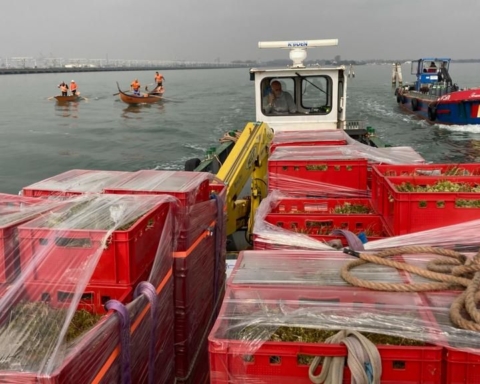
I spent most of March and April of 2022 in Venice, Italy weaving a 60-square-meter carpet of living Sphagnum as part of Ensayos’ contribution to “Turba Tol Hol-Hol Tol” for the Chilean Pavilion of the 59th Venice Biennale. Read an account of the residency and project here.
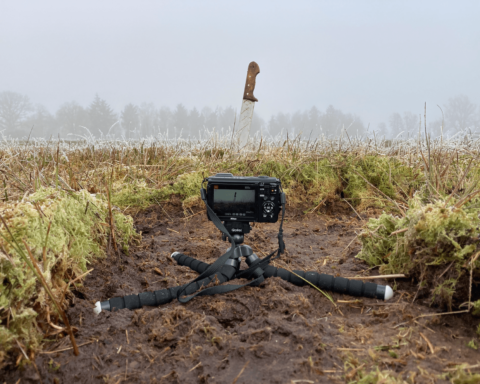
Three-week residency at Greifswald Mire Centre in preparation for Ensayos’ contribution to “Turba Tol Hol-Hol Tol,” the Chilean Pavilion at the 59th Venice Beinnale.
Video presentation for MEANDER presents: Ecological Thinking and Artistic Practice
By Caitlin Franzmann, Christy Gast and Randi Nygård
Ensayos is a collective research practice initiated on the archipelago of Tierra del Fuego in 2010. Ensayos’ issue-based research methodologies arise from archipelagic delirium and are characterized by their sensuality and precariousness. In partnership with the existing ecological and cultural conservation initiatives on the main isle of Tierra del Fuego (WCS Parque Karukinka, Caleta Maria, Fundación Hach Saye), Ensayos entangles artistic practices, social science methods and Indigenous movements with pressing environmental research. Dedicated to policy, care, and awareness of the ecosystemic importance of peat bogs, Ensayo #6 is committed to the biodiversity conservation processes of the new Patagonian Peatland Initiative and others like it around the world. Randi Nygård (Norway), Caitlin Franzmann (Australia) and Christy Gast (USA) will give presentations about poethical issues related to their local bogs.
Insectageddon is a collective performance and call to action presented by artist and poet Cecilia Vicuña. The event addresses the devastating loss of insect populations around the world due to the immense scale of toxic industrial farming, pesticides, and habitat destruction. Insectageddon celebrates the millions of insects that visit and make their home on the High Line every year. Vicuña uses the wild and lively landscape of the park to remind us of the importance of insects for maintaining our vegetal world, as well as all living beings that rely on plants to live.
Cecilia Vicuña is an artist and poet based in New York City originally from Santiago, Chile. Vicuña’s work connects deeply with the changing realities of natural and political realms. In her precarios (works made of natural and industrial debris) and quipus (large hanging installations of knotted skeins made of unspun wool), she embraces the impermanence of material realities in our world, celebrates unexpected magical moments of transformation, and mourns the loss of nature’s beauty that we ourselves precipitate.
Insectageddon takes place as part of the High Line’s annual Horticulture Celebration as an expanded festival on the High Line and at dozens of partner sites across New York City and around North America. Learn more about our site partners. The work follows the life cycle of the butterfly: from life, through death, and back to life anew, and centers the voices of children as today’s leaders in climate change activism. For the event, Vicuña and the event’s partners bring together artists, activists, citizen scientists, climate change scholars, entomologists, performers, and most importantly, young people, in an effort to both reflect and raise awareness for our interconnectedness in the web of life.
Please note that the High Line has a timed-entry reservation system on weekends. For entry to the park, make a timed-entry reservation. No separate reservation is needed for the event.
3 – 6pm
At the 10th Avenue Overlook at 17th Street
Poets, scientists, artists, and climate activists speak about their work involving insects and ways we can move forward together. Presentations will take place in the 10th Avenue Overlook at 17th Street. Speakers include: sixth-grade entomologist Anusha Vaish; mycologist Giuliana Furci; renowned activist Bertha Lewis; bee biologist and Field Associate at the American Museum of Natural History Sarah Kornbluth; High Line staff gardener Scout Kerensky-Coodley; Cecilia Vicuña and musician Ricardo Gallo; and the revered theatrical troupe Reverend Billy and the Stop Shopping Choir; among others.
3 – 4pm
The Backyard at Hudson Yards
Near 32nd Street and 11th Avenue
8 – 9pm
In the 14th Street Passage, on the High Line at 14th Street
Artists and filmmakers present a series of videos and short films exploring the profound creativity and ingenuity of insects. The series features:
Aaron Huey, There is No Us Without Them (2021)
Cecilia Vicuña with Riccardo Gallo and Robert Kolodny, Death of the Pollinators (2021)
Pedro Neves Marques, YWY, The Android (2017)
Matthew Wilson, Geological Evidences (2017)
Maria Fernanda Cardoso, On the Origins of Art I & II (2016)
Isabella Rosellini, Green Porno: Bee, Mantis, Spider (2008)
Cecilia Vicuña, Rari en New York (Directed by Jody Shapiro and Isabella Rossellini)
3 – 6pm
In the Chelsea Market Passage, on the High Line between 15th and 16th streets
Celebrating Insects: Insect masks and endangered and beneficial insects
Hosted by High Line Education
During this workshop, we’ll explore why insects are important and what we can do to protect them. After learning about endangered insects and why insects are important, participants will be invited to create an insect mask inspired by four endangered insects that call New York State home. Participants will use paper, markers, cardstock, and string to design their mask, choosing to create pop-up elements or decorate the mask with drawing supplies.
Celebrating Insects: Cecilia Vicuña, artist spotlight and mini wire insect sculptures
Hosted by High Line Education
In this workshop, participants will learn about Cecilia Vicuña and her body of work. Participants will create a small wire sculpture of an insect out of various wire materials. This sculpture will be attached to a pencil to mimic the movement of insects while writing or drawing. These sculptures reference Cecilia’s insect hat, as well as wire kinetic sculpture that will appear during the festival.
Celebrating Insects: Exploring native bees on the High Line
Hosted by High Line Education
In this experience, participants will learn about the essential role different kinds of native bees play on the High Line, what they need to thrive, and how pesticides, habitat loss, and climate change threaten their survival. Participants will be invited to explore a bee box by taking it apart and putting it together, learn about the different types of native bees in the “Which bee lives where?” matching game, and draw different kinds of native bees found on the High Line.
iNaturalist Workshop
Hosted by Chris Kreussling, aka “Flatbush Gardener”
Join Chris Kreussling for a walk on the High Line to explore plant and insect interactions and learn about the citizen scientist observation gathering tool iNaturalist. Tours begin at 3:30 and 4:45; please sign up upon arrival at Chris’s table in Chelsea Market Passage. Chris is a Brooklyn naturalist and gardener specializing in gardening with native plants to create habitat for pollinators and other invertebrates.
Native Plant Finder Workshop
Hosted by Sarah Ward, National Wildlife Federation
Did you know that a native oak tree can support the caterpillars over 500 species of butterflies and moths? When it comes to attracting beautiful bees, butterflies, and birds to your yard or community garden, the best thing you can do is use native plants. Join National Wildlife Federation to explore their Native Plant Finder which will help you find the best native plants for your specific zip code that attract butterflies, moths, and the birds that feed on their caterpillars.
3:30 – 6pm
At various locations on the High Line
Francisca Benitez and Sunder Ganglani, Bombus impatiens and other harmonies
3:30pm
On the Flyover, on the High Line between 25th. and 27th streets
Benitez and Ganglani will present a harmonizing vocal duet inspired by the Latin and common names of the insects found on the High Line in synchronicity with an ASL interpreter.
Christy Gast, Goldenrod Transect
4pm
Meet on the High Line at Gansevoort Street
Gast will present a durational performative walk around a native plant found in several locations throughout the High Line, goldenrod. Gast will have with her a giant soft sculpture of a goldenrod, as a prop for educational, creative, and interactive collaboration with the public. The performance will travel between Gansevoort Street and 16th Street.
Poet’s ANThology (A living ANThology)
4:30pm
Throughout the park
Invited poets will perform at different spots throughout the High Line, spontaneously in conversation with guests. Poets will be wearing insect cyborgian costumes designed by Cecilia Vicuña and created by Gregory Corbino. The Poet’s ANThology will culminate at the 10th Avenue Overlook with a poetry performance by Cecilia Vicuña. Poets include Omar Berrada, Lee Ann Brown, Laynie Brown, Brenda Coultas, Latasha Diggs, Marcella Durand, Lucía Hinojosa Gaxiola, E.J. McAdams, Sarah Riggs, Eleni Sikelianos, Edwin Torres, and Anne Waldman.
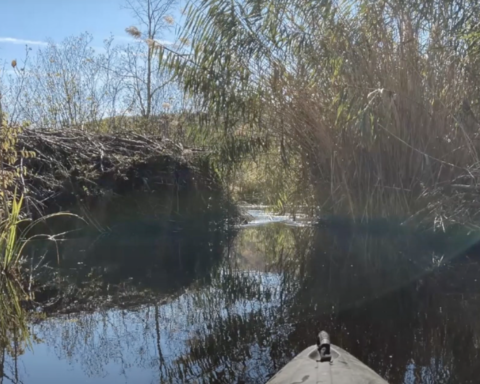
Loss and Wonder at the World’s End by anthropologist and writer Laura A. Ogden has been published by Duke University Press. In a chapter on “Speculative Wonder,” Dr. Ogden discusses collaborating with Ensayos on Ensayo #2: Asunto Castor.
From Duke University Press:
In Loss and Wonder at the World’s End, Laura A. Ogden brings together animals, people, and things—from beavers, stolen photographs, lichen, American explorers, and birdsong—to catalog the ways environmental change and colonial history are entangled in the Fuegian Archipelago of southernmost Chile and Argentina. Repeated algal blooms have closed fisheries in the archipelago. Glaciers are in retreat. Extractive industries such as commercial forestry, natural gas production, and salmon farming along with the introduction of nonnative species are rapidly transforming assemblages of life. Ogden archives forms of loss—including territory, language, sovereignty, and life itself—as well as forms of wonder, or moments when life continues to flourish even in the ruins of these devastations. Her account draws on long-term ethnographic research with settler and Indigenous communities; archival photographs; explorer journals; and experiments in natural history and performance studies. Loss and Wonder at the World’s End frames environmental change as imperialism’s shadow, a darkness cast over the earth in the wake of other losses.
In Chapter Five, Dreamworlds of Beavers, after an interlude on Lewis Henry Morgan’s fascination with the architectural industry of beavers, Laura recalls a series of collaborative thought experiments with feminist artists and filmmakers Christy Gast and Camila Marambio. In these pieces of performance art or “undisciplined research,” the artists strive to make beavers visible participants in the “decision-making about their own future.”
“Throughout, I track the surprising ways in which a pair of human-sized beaver costumes attune their wearers to beaver life,” Laura writes.
This project has been supported by Karukinka Nature Park on Isla Grande, within Chilean Tierra del Fuego. Karukinka is managed by the Wildlife Conservation Society, a North American environmental organization. The project (“called Ensayos”) was developed to bring artists, social scientists, and natural scientists together to think about conservation problems at the park. The National Science Foundation’s Coupled Natural and Human (CNH) Systems program provided additional support for this project (PI Chris Anderson), as did support from the Claire Garber Goodman Fund at Dartmouth College.